The rate of hospital admissions with cannabis-related harm as the main diagnosis rose 49% over a decade in Victoria, Australia. The study’s lead author explains what the numbers count.
Cannabis Hospital Admission Findings
The rate of hospital admissions in which cannabis-related harm was the main diagnosis rose 49% over a decade in Victoria, Australia, according to a study published October 11 in Addiction.[1] The finding points to a growing burden on hospitals, especially involving mental health. The records cover July 2013 through June 2023, rather than a new surge measured in 2026.[1]
Fast Facts About Cannabis Hospital Admissions
- The study covers hospital admissions in Victoria, Australia, from July 2013 through June 2023.[1]
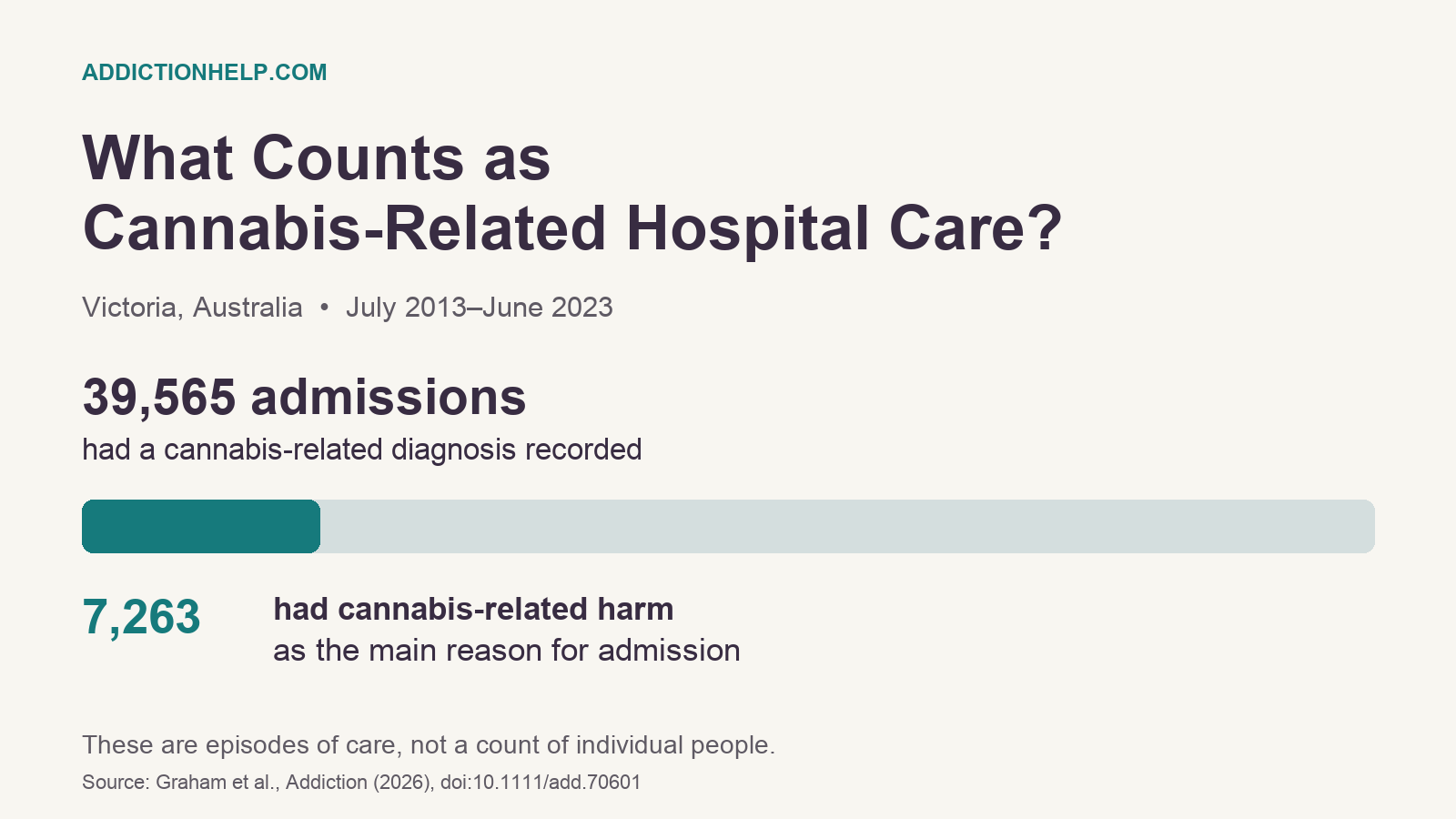
- Researchers identified 39,565 admissions with any cannabis-related diagnosis, including 7,263 with cannabis-related harm as the principal diagnosis.[1]
- The Victoria study counts episodes of hospital care, and the same person could have more than one admission.[1]
To understand that increase, it helps to ask two questions: What counted as a cannabis-related admission, and whose risk was measured? Lead author Myfanwy Graham, from the Monash Addiction Research Centre, explained those distinctions in written comments to addictionhelp.com.
What Counted as Cannabis-Related Harm?
In this study, cannabis-related harm meant a recorded diagnosis of cannabis poisoning or a mental or behavioral disorder related to cannabinoid use. That included psychotic disorders, harmful use, dependence, withdrawal and acute intoxication. It did not simply mean that someone had used cannabis.[1]
Of the 39,565 admissions identified, 7,263 (18.4%, or just under one in five) had cannabis-related harm as the main diagnosis.[1] In the remaining 32,302 admissions, a cannabis-related diagnosis was recorded alongside a different main diagnosis.[1]
39,565 hospital admissions in Victoria, July 2013–June 2023.[1]
- 18.4% (7,263 admissions): Cannabis-related harm was the main diagnosis.[1]
- 32,302 admissions: A cannabis-related diagnosis was recorded alongside a different main diagnosis.[1]
Both groups had a cannabis-related diagnosis. These percentages describe admissions, not individual risk.[1]
This distinction does not divide the admissions into “harm” and “no harm.” It tells us whether a cannabis-related condition was recorded as the main reason for hospital care. The percentage describes admission episodes in Victoria from July 2013 through June 2023, not the chance that a person who uses cannabis will be hospitalized.[1]
What the 49% Increase Measures
The researchers examined admission records from Victoria’s public and private hospitals. A principal diagnosis is the main reason for admission.[1]
“A cannabis-related principal diagnosis means a cannabis-related diagnosis was identified as the primary clinical reason for a patient’s hospital admission,” Graham said.
The 49% figure compares the rate of those principal-diagnosis admissions in the final study year, 2022–2023, with the first, 2013–2014.[1] Researchers accounted for population size, age group and sex in that comparison. It describes a change in admissions relative to the population, rather than simply a larger raw total as Victoria grew.[1]
A cannabis-related diagnosis elsewhere in the record means something different. The person was admitted primarily for another condition, with a cannabis-related diagnosis also recorded. Among those admissions, common principal diagnoses included schizophrenia, other substance-related disorders, and nausea and vomiting. Counting them helps describe hospital care involving cannabis-related harm, but does not establish that cannabis caused every admission.[1]
Why Psychosis Features Prominently
Among the 7,263 admissions with cannabis-related harm as the principal diagnosis, 2,909, or 40.1%, had a cannabis-related psychotic disorder as that diagnosis.[1] Other principal diagnoses included harmful use, withdrawal, poisoning, intoxication and dependence.[1]
The 40.1% figure describes a selected group of hospital admissions.[1] It is not the proportion of cannabis users who develop psychosis, and it does not describe all 39,565 admissions in the study.[1]
Psychosis involves difficulty distinguishing what is real and can include hallucinations or paranoia. The Centers for Disease Control and Prevention notes that cannabis use is associated with psychosis and schizophrenia, and that the association with schizophrenia is stronger among people who begin using earlier and use more frequently.[2]
That broader evidence helps explain why the hospital findings deserve attention. The admission study itself cannot tell someone their probability of developing a psychotic disorder. Our guide to cannabis and psychosis explains symptoms, assessment and help in more detail.
If you are in emotional distress or a mental health crisis in the United States, call or text 988 or chat online with a crisis counselor. Support is free, confidential and available 24/7.[3]
Admissions Are Not Individual People
The dataset counts episodes of hospital care. One person can be admitted more than once, so 39,565 admissions does not mean 39,565 different people.[1] Transfer episodes were excluded to avoid counting a single episode more than once, but separate episodes for the same person could still contribute to the total.[1]
“The rates presented are for admissions rather than individual people, and it is possible that the same person may have had multiple episodes of care,” Graham said in her written response.
For an illustrative example, one person admitted on three separate occasions can contribute three admissions. Those episodes represent real care needs, but do not mean three different people were hospitalized. This is why a hospital workload measure and an individual’s chance of needing hospital care answer different questions.
To estimate risk among people who use cannabis, researchers would also need an appropriate measure of that population and its exposure. This study did not distinguish prescribed from illicit cannabis or record product composition, dose, route of use or reason for using. It therefore cannot establish whether a particular product or pattern of use explains the increase.[1]
Who Had the Highest Admission Rates?
Principal-diagnosis admission rates were highest among people ages 15 to 24, with higher rates among males than females in that age group.[1] Across the study population, females had a larger relative increase between the first and last years than males, 75.1% compared with 34.6%.[1] A larger percentage increase does not mean females had the highest admission rate.[1]
The trend also had peaks and declines. Overall cannabis-related admission rates peaked in 2020–2021 and were lower in the following two years.[1] The 49% comparison between the first and last years should not be read as a steady annual rise.[1]
Changes in diagnosis, coding and willingness to disclose cannabis use may affect what appears in hospital records. The study cannot separate all those influences. It also cannot establish that a cannabis policy change caused the increase. Its findings concern Victoria, and should not be treated as a U.S. hospitalization estimate or a description of conditions today.[1]
What Readers Can Use From the Findings
The study makes mental-health harms an important part of the cannabis conversation. It also shows why a broad “cannabis-related” label needs explanation. Someone reading a hospital statistic deserves to know whether it counts people or admissions, what diagnosis was involved, and which years and place it describes.
If cannabis use is affecting your mental health, the CDC’s explanation of anxiety, paranoia and psychosis provides a reason to discuss those experiences with a healthcare professional.[2] These questions can help start that conversation:
- Could my cannabis use be contributing to the changes I am noticing?
- What symptoms should prompt me to seek help?
- What support is available if changing my use feels difficult?
You can bring information about the products you use, how often you use them and when symptoms occur. Those details help make the conversation specific. They are also the kinds of details missing from a hospital admission count, which is why this study cannot give a personal risk estimate.[1]
For broader questions, our marijuana addiction guide covers signs of problematic use and support options. Our marijuana statistics page addresses U.S. use patterns. The Victoria study adds a different piece: a closer look at the hospital care recorded when cannabis-related harm was involved.
Reporting note: Graham supplied written answers to addictionhelp.com. She is an author of the study. The paper discloses her membership in Australia’s Therapeutic Goods Administration Medicinal Cannabis Expert Working Group and states that it does not represent the group’s or agency’s views.[1]
Get Treatment Help
If you or someone you love is struggling with addiction, getting help is just a phone call away, or consider trying therapy online with BetterHelp.
Exclusive offer: 20% Off BetterHelp*Following links to the BetterHelp website may earn us a commission that helps us manage and maintain AddictionHelp.com. *Get 20% off your first month of BetterHelp. Offer valid for new BetterHelp users only. Offer cannot be combined with insurance.

- Fact-Checked
- Editor