Porn Addiction Effects
Problematic pornography use can disrupt sleep, relationships, sexual health, and emotional well-being. Difficulty controlling use and its impact on daily life can guide the next step for help.


Battling addiction & ready for help?
Understanding Porn Addiction Side Effects
Losing sleep, avoiding a partner, or repeatedly watching longer than you intended can leave you wondering what is happening. You deserve an answer that takes those concerns seriously. Start with the changes you can describe, such as missed commitments, difficulty stopping, or tension around sex, rather than trying to decide whether your brain has been damaged.
Problematic pornography use, often called porn addiction, involves use that is difficult to control and causes distress or interferes with life. It can be part of compulsive sexual behavior disorder. Assessment considers control, consequences, and the source of distress. Frequency alone does not tell the whole story.[1]
The effects are not identical for everyone. A person struggling with secrecy and lost time may need different help from someone experiencing sexual difficulties or distress about religious values. Understanding porn addiction can help you describe the pattern.
- Difficulty controlling pornography use deserves attention when it continues despite harm, even without an existing diagnosis.[1]
- Pornography use is linked with sexual dissatisfaction and relationship difficulties in some studies. These findings do not establish that it causes those problems for everyone.[2][3]
- Brain studies explore how cues, learning, and reward may relate to problematic use. Group differences do not establish that your brain is damaged.[4][5]
- Talk therapy (psychotherapy) can improve problematic use and related symptoms. Recovery goals should address the specific effects on your life.[6]
Porn Addiction Side Effects in Everyday Life
A useful starting point is what has changed outside the screen. Clinical assessment looks at interference with responsibilities, relationships, health, and other interests, alongside efforts to control the behavior. You can ask for help with your porn use before every area of life is affected.[1]
Use the following questions to prepare for a conversation. They are prompts for describing your situation, not a scoring system or a diagnosis.
Scroll sideways to see all columns. Use arrow keys when focused.
| Area of life | What to notice | A concrete example to bring to care |
|---|---|---|
| Time and responsibilities | Whether viewing repeatedly displaces something important | “I planned to sleep, but stayed up watching and missed work.” |
| Control | What happens when you decide to stop or change your use | “I keep setting a limit and going past it.” |
| Relationships | Secrecy, broken agreements, conflict, or withdrawal from a partner | “We keep arguing about an agreement I have not kept.” |
| Sexual health | Changes in desire, arousal, comfort, or partnered sex | “Sex has become stressful, and I want help understanding why.” |
| Emotional well-being | Distress before or after viewing, including anxiety or shame | “I use it when I am lonely, then feel worse about myself.” |
These examples can also help separate a concern about behavior from a concern about what the behavior means to you. Both are worth discussing. Consider which warning signs of problematic use fit the pattern you want to discuss.
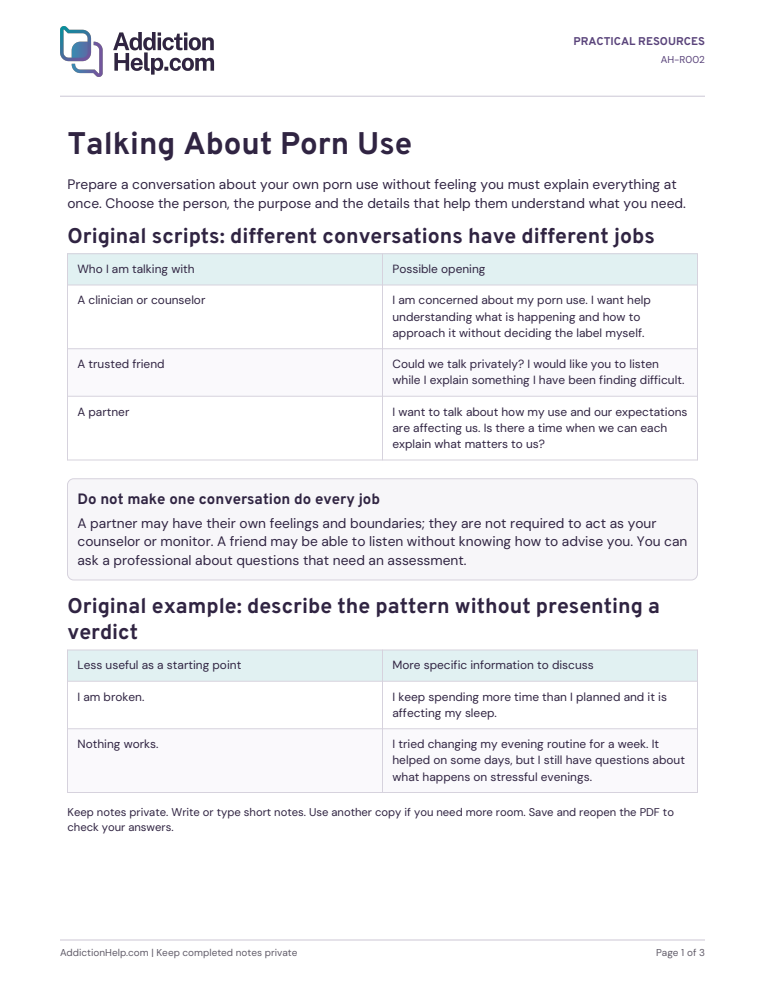
AddictionHelp.com · Practical resources
Talking About Porn Use
Prepare a conversation about your own porn use without feeling you must explain everything at once. Choose the person, the purpose and the details that help them understand what you need.
3-page fillable PDF · Free · No signup
Choose a Next Step for Porn-Related Problems
If lost time is your main concern, use a plan for changing porn use to choose one routine to work on. If you keep trying to change and feel stuck, prepare questions for porn addiction counseling. If a sexual symptom concerns you, ask a clinician to assess it alongside your medical history rather than assuming pornography is the cause.[1]
To explore available care, compare the online-therapy and directory routes at Find Treatment Help. Ask prospective providers whether they assess problematic pornography use and what an initial appointment would involve.
How Porn Use Relates to Relationships and Sex
Pornography can become part of a relationship conflict when partners have different expectations, when someone conceals behavior, or when use interferes with intimacy. The important question is what is happening between the people involved. A statistic cannot determine whether your relationship is healthy or what boundaries you should accept.[1][3]
Porn Use and Sexual Satisfaction
A review combining results from 41 studies involving 70,541 people found a small negative association between pornography use and sexual satisfaction.[2] The overall correlation was −0.06, a very weak relationship between higher use and lower satisfaction.[2] Your own sexual concerns still deserve attention, even when the average association is small.[2]
The association was somewhat stronger in studies following participants over time than in studies measuring use and satisfaction at one point in time. Even so, these findings do not settle whether pornography use lowered satisfaction, lower satisfaction influenced use, or other factors contributed to both. A clinician needs your history, not just the average result.[2]
Differences in Partners’ Porn Use
In a study of 1,755 heterosexual couples, differences in partners’ pornography use were associated with lower relationship satisfaction and stability and with differences in communication and conflict.[3] This makes mismatched habits an important subject to discuss.[3]
A separate daily-diary study followed 217 same-sex and mixed-sex couples for 35 days. Solitary pornography use on days when the couple had sex was associated with greater sexual distress in the other partner. The study did not find an association with several other outcomes, including sexual satisfaction. Timing and context mattered, and the findings were mixed.[7]
For a conversation at home, distinguish the behavior from the agreement: “We said we would discuss this, and that did not happen” is more specific than “Porn has ruined everything.” Consider which relationship boundaries around pornography you want to discuss.
Does Porn Cause Erectile Dysfunction?
Erectile difficulties deserve an assessment of possible causes, including physical health, mental health, medications, and sexual context. Pornography use may be relevant, but frequency alone cannot identify the cause. Research gives different answers in different groups of men.[8][9]
Scroll sideways to see all columns. Use arrow keys when focused.
| Study population | Finding | What it can tell you |
|---|---|---|
| 3,586 men in a general sample[8] | Pornography frequency was not related to erectile functioning or erectile dysfunction severity after accounting for other factors. Age, anxiety or depression, and chronic medical conditions were more consistent predictors. | A blanket claim that frequent pornography use causes erectile dysfunction is not supported by this study.[8] |
| 66 young, married heterosexual men with psychogenic erectile dysfunction, meaning erection difficulties attributed to psychological factors after physical causes were excluded | More frequent pornography use was associated with worse erectile function. | A finding in this selected clinical group should not be applied to every man. Measuring use and symptoms at one point in time cannot establish which came first.[9] |
A 2016 narrative review proposed that novelty and patterns of arousal during internet pornography use could contribute to some sexual difficulties. It included clinical reports, rather than a trial proving that pornography caused the problems or that stopping reliably resolved them. It is a hypothesis that merits investigation, not a diagnostic rule.[10]
If erections are easier during pornography use than with a partner, describe that difference to a clinician. It can inform assessment, but it does not prove that pornography is the cause. Avoid assuming that a fixed period of abstinence will resolve a symptom that may need other care. Read more about pornography use and erectile dysfunction.
Porn Use, Anxiety, Depression, Loneliness, and Shame
Problematic pornography use is associated with psychological distress. A nationally representative U.S. study of 2,773 adults found associations with anxiety, depression, and loneliness.[11] The connection between frequent use and problematic use was stronger at higher levels of loneliness. These findings support asking about emotional health alongside the behavior.[11]
Does Porn Use Cause Emotional Distress?
The research does not support a simple answer for everyone. A one-year study of 4,363 U.S. adults found that problematic use and distress were strongly related between people over time.[12] It did not demonstrate a straightforward cycle in which increases in one reliably caused increases in the other within the same person.[12]
In another study, young adults with both depression and anxiety symptoms had 2.72 times the odds of daily pornography viewing compared with those with neither.[13] Odds compare how often daily viewing occurred with how often it did not. This association concerns viewing frequency, not the chance of having an addiction.[13]
For your own care, the practical question is whether both concerns need attention. Tell a clinician if depression, anxiety, or loneliness is present before viewing, afterward, or throughout the day. Reducing viewing should not become a reason to postpone help for persistent emotional distress.[1]
Distress About Values Is Real Too
A study found that perceived addiction was associated with psychological distress beyond the amount of pornography someone reported using. Research on moral incongruence also describes distress when behavior conflicts with personal beliefs. This does not mean the distress is imaginary or that a person’s values should be dismissed.[1][14]
Assessment should distinguish loss of control from distress based entirely on moral disapproval, while recognizing that both may coexist. A useful treatment goal can include changing behavior, reducing shame, improving coping, or discussing a values conflict. It should be agreed with you rather than imposed.[1]
What Pornography Research Shows About the Brain
Brain research explores why sexual cues can attract attention and why a pattern may become difficult to change. It does not provide a scan-based test for porn addiction. A group difference is not a diagnosis of brain damage, and these studies cannot tell you what is happening in your brain from a description of your habits.[1][4][5]
Responses to Cues That Predict Pornography
A 2017 imaging study compared 28 heterosexual men seeking treatment for problematic pornography use with 24 heterosexual men without problematic pornography use. The treatment-seeking group showed a greater response in a reward-related brain region to cues predicting erotic pictures. The groups did not differ in their response to the erotic pictures themselves.[4]
That distinction matters. The study supports a role for anticipation and motivation in problematic use. It does not show that every person’s brain reacts more strongly to a cue than to pornography itself, nor does it establish an individual “fingerprint” of addiction. It helps explain a possible mechanism rather than deciding who has a disorder.[4]
Learning and Remembering Sexual Cues
A 2025 experiment involving men with compulsive sexual behavior found differences in learning that a cue predicts a reward (conditioning) and then learning that it no longer does (extinction). Some differences also involved monetary rewards. The findings concern learning under laboratory conditions, including responses to different types of rewards.[15]
A later study compared 23 men with problematic use and 35 men without problematic use.[16] It found differences in brain activity when recalling learned links between cues and rewarding pornography images, called appetitive memories, and when learning that those cues no longer predicted the images. This is evidence about learning processes in a small research sample, not proof that a memory is permanent or a prediction of recovery time.[16]
Brain Structure Findings Need Context
A frequently cited 2014 study involved 64 healthy men, not a group diagnosed with compulsive pornography use. More reported hours of viewing were associated with a smaller measured volume of brain tissue called gray matter in the right caudate, a brain region. The scans also showed differences in activity during a sexual-cue task and in how activity in brain regions was linked.[5]
The study could not determine whether viewing caused the differences or whether preexisting differences influenced viewing. Describing it as proof that pornography shrinks or damages the brain goes beyond its design. The more detailed brain research on pornography should be read with that same distinction in mind.
Attention, Memory, and Self-Control
A systematic review of 21 experimental studies reported associations between problematic use and several cognitive processes. These were research tasks and group comparisons. They are not a checklist that can tell you whether ordinary distraction or forgetfulness comes from pornography.[17]
Scroll sideways to see all columns. Use arrow keys when focused.
| Research finding | Plain-language meaning |
|---|---|
| Attentional bias | Sexual cues can capture attention more readily in some studied groups. |
| Differences in response inhibition | Some tasks found greater difficulty stopping a response. |
| Working-memory differences | Some studies found difficulties holding and using information during a task. |
| Decision-making differences | Some tasks found preferences for immediate rewards or altered choices under uncertainty. |
If concentration or memory has changed, bring the symptom and its timing to a clinician. Do not use the table to diagnose yourself or assume that one behavior explains every difficulty.
Who Reports Problems With Pornography Use?
Studies often find higher problematic-use scores among men, but women can experience these difficulties too. Research has also relied heavily on male samples. Findings about one gender, age group, or country should not be presented as a universal profile of who needs help.[1][18]
Problematic Porn Use in Men and Women
An internet-recruited Swedish study of 1,913 young adults reported problems with sexual internet use in about 13% of men and 5% of women.[19] Serious problems were reported by about 5% and 2%, respectively.[19] These are findings from that sample and its measure of sexual internet use. They are not current U.S. rates of diagnosed porn addiction.[19]
Population differences are a reason to ask better questions, not to dismiss someone whose experience differs from the typical study participant. When comparing pornography statistics, check the population and what each measure counts.
Emotional Coping and Craving
A study of 340 participants found relationships among emotion-regulation difficulties, loneliness, and problematic-use scores.[18][20] Another study, measuring 280 Pakistani adults at one point in time, examined depression, anxiety, self-esteem, craving, and coping. Its statistical model did not prove a sequence in which distress causes craving and then causes loss of control.[18][20]
Still, the function of the behavior is a useful subject to explore. Are you seeking pleasure, avoiding a feeling, postponing sleep, or trying to cope with loneliness? The answer can help identify what your plan needs to address. Consider possible causes and contributing factors without assuming one explanation fits everyone.
What Causes Porn Addiction and Its Effects?
Porn-use problems can involve several interacting factors. Difficulty managing emotions, loneliness, learned cues, and repeated patterns of use may play a role. The reasons differ from person to person, and a link found in a study does not establish what caused an individual person’s problem.[1][18]
For some people, pornography becomes a way to respond to distress. For others, particular situations or sexual cues become closely tied to urges. Research on emotional coping and cue responses helps explain possible patterns. It does not show that everyone who views pornography will develop them.[4][18]
Ask what happens before you use pornography, what you get from it in the moment, and what happens afterward. Those details can help you discuss causes and contributing factors in porn addiction with a clinician and choose a change that addresses the pattern.[1]
Can Treatment Help With Porn-Related Problems?
People can improve, and treatment offers reasons for hope. A 2025 review combining results from 20 studies involving 2,021 participants found improvements with psychotherapy in problematic pornography use and related outcomes.[6] The studies had substantial limitations, including risk of bias and limited diversity, so the results cannot promise that every effect will reverse.[6]
In their 2024 sexual-medicine recommendations, Peer Briken and colleagues describe treatment goals that extend beyond reducing sexual behavior to supporting a satisfying sexual life. For your appointment, try completing this sentence: “Alongside changing my porn use, I want help with ___.” Your answer might identify a relationship concern, sexual difficulty, or distress that deserves attention in its own right.[1]
Therapy and Recovery Skills
A 2026 review mapped 11 studies of approaches based on cognitive behavioral therapy (CBT), which works on unhelpful thoughts and behavior patterns. Approaches also included acceptance and commitment therapy (ACT), which builds skills for responding to thoughts and urges, and mindfulness-related methods.[21]
The studies reported improvement but did not establish one standardized treatment. Counseling for problematic pornography use can address triggers, coping, values, and the consequences that matter to you.[21]
One randomized ACT trial enrolled 28 adult men, almost all from the same religious community.[22] Viewing decreased more in the treatment group than in the waitlist group. The small, specific sample limits generalization, but the trial contributes to evidence that skills for responding to thoughts and urges can be taught.[22]
Online Support and Choosing a Goal
A six-week randomized study of the Hands-off online self-help program found improvements among participants who completed follow-up. Dropout was very high, especially in the intervention group. The findings apply to this tested program and its follow-up participants, rather than recovery apps in general.[23]
In a study of help-seeking men, negative symptoms related to pornography use were more closely associated with seeking treatment than the amount viewed. This supports looking beyond frequency. It does not mean that distress alone establishes a disorder, particularly when values conflicts or other health concerns may be involved.[1][24]
Choose one concrete goal to bring to care:
- Sleeping on time.
- Keeping an agreement.
- Feeling more control over pornography use.
- Addressing a sexual symptom.
Prepare by choosing steps for changing pornography use and recovery goals that fit your concern. If cutting back feels difficult, changes people report when stopping deserve careful attention rather than an assumed withdrawal diagnosis.
Find Help for Porn-Related Problems
You do not need to solve every problem before asking for support. Use porn addiction resources to compare help options, questions to bring to counseling, and ways to learn more. Choose the concern affecting your life most and make that the first conversation.
If you have thoughts of suicide or are in emotional distress, call or text 988 in the United States. Call 911 for immediate danger.[25]
Frequently asked questions
Can Porn Addiction Damage Your Brain?
Imaging studies report differences in brain activity and structure in particular samples. They do not establish that an individual has brain damage or that pornography caused the differences. Persistent loss of control or interference with life deserves assessment without using a brain-damage label.[1][4][5]
Can the Effects of Porn Addiction Be Reversed?
Does Pornography Cause Erectile Dysfunction?
Research findings differ by population. A large general sample found no relationship between pornography frequency and erectile functioning, while a small study of men with erectile dysfunction attributed to psychological factors after physical causes were excluded found an association. Neither result diagnoses the cause of your symptoms. A clinical assessment can consider other contributors.[8][9]
Can Women Experience Problematic Pornography Use?
How Much Pornography Is Too Much?
There is no frequency cutoff that answers this for everyone. Assessment considers difficulty controlling behavior, interference with life, continued use despite consequences, and the source of distress. High frequency alone or distress entirely from moral disapproval does not establish compulsive sexual behavior disorder.[1]
When Should I Ask for Help?
Ask when you are struggling to control use, repeatedly losing time or sleep, experiencing relationship or sexual difficulties, or feeling distressed and unsure what is happening. You do not need to diagnose yourself first. An assessment can clarify the concern and help you choose a suitable next step.[1]
Get Treatment Help
If you or someone you love is struggling with addiction, getting help is just a phone call away, or consider trying therapy online with BetterHelp.
Exclusive offer: 20% Off BetterHelp*Following links to the BetterHelp website may earn us a commission that helps us manage and maintain AddictionHelp.com. *Get 20% off your first month of BetterHelp. Offer valid for new BetterHelp users only. Offer cannot be combined with insurance.

- Fact-Checked
- Editor