Porn Addiction Counseling
Counseling can help people understand and change pornography use that feels difficult to control or is interfering with daily life.


Battling addiction & ready for help?
Counseling for Problematic Porn Use
Counseling can help people understand and change pornography use that feels difficult to control or is interfering with daily life. Treatment may involve identifying triggers, practicing ways to respond to urges, addressing emotional distress, and setting goals that fit the person’s circumstances. Research supports psychotherapy as a promising option, while leaving important questions about which approaches work best and for whom.[1][2]
You do not need to arrive with a diagnosis or a perfect explanation. An initial appointment can begin with what worries you: time lost to viewing, repeated attempts to cut back, relationship conflict, or distress about how pornography fits with your values. A careful assessment helps distinguish these concerns instead of assuming everyone needs the same treatment.[3]
For background on terminology and symptoms, see our Porn Addiction guide.
- Assessment comes first. A clinician considers control, consequences, mental health, and personal values rather than diagnosing a problem from viewing frequency alone.[3]
- CBT and ACT have promising evidence. Studies support these approaches, but limited study quality prevents firm promises about outcomes.[2]
- Online care takes different forms. A self-guided program and live counseling are different services; check what support is included.[4][5]
- Goals should fit the person. Care should support sexual health without imposing the clinician’s moral views.[3]
If you are in the United States and are suicidal or in emotional distress, call or text 988. For a life-threatening emergency, call 911 or go to the nearest emergency room.[4]
When Porn Use Is a Reason to Seek Counseling
The amount of pornography someone views does not, by itself, establish a mental health disorder. Clinicians consider impaired control, consequences, and how the behavior affects functioning. A strong sex drive, masturbation, or a sexual interest is not automatically a disorder. Distress arising entirely from moral disapproval is also different from the persistent loss of control involved in compulsive sexual behavior disorder, or CSBD.[3]
That distinction should make an assessment more useful, not dismiss someone’s distress. A person may want help with pornography use because they repeatedly miss sleep or responsibilities, keep returning to a behavior despite serious consequences, or feel caught between their behavior and personal beliefs. Counseling can explore what is happening and what the person wants to change without treating shame as proof of addiction.[3]
Porn Use, Urges, and Everyday Patterns
Treatment research describes craving, responses to sexual cues, and difficulties regulating behavior as relevant to problematic pornography use. These are possible treatment targets, not a way to determine from a website whether someone’s brain is damaged or whether they have a diagnosis. People also differ in the role that stress, loneliness, emotional difficulties, and other mental health concerns play in their behavior.[1][3]
A practical starting point in therapy is to describe a recent episode: what happened beforehand, what you were feeling, what you expected viewing to do for you, and what happened afterward. Cognitive behavioral approaches use this kind of information to identify patterns and develop alternative responses. The goal is to understand a sequence that can change, rather than reduce the person to a label.[1]
Pornography Use and Personal Values
A therapist should be able to discuss personal or religious values respectfully while also asking about actual control and impairment. A person can experience both moral conflict and difficulties regulating behavior; the assessment should not force those experiences into an either-or explanation. Sexual medicine recommendations emphasize individualized care and warn against imposing a clinician’s own moral judgments.[3]
You can ask how a therapist distinguishes problematic use from distress about otherwise controlled behavior. That question is especially useful when your main concern is guilt or when someone else has told you that any pornography use necessarily means addiction.[3]
What Happens in Porn Addiction Counseling?
An assessment usually looks beyond viewing frequency. Sexual medicine recommendations call for a sexual and medical history, a review of mental health and substance use, and attention to medications and other factors that might affect behavior. A clinician may also ask about relationships, previous attempts to change, and what the difficulties are costing you.[3]
It would be misleading to promise that a therapist will never ask about sexual experiences or personal history. Some of those questions can be relevant to an assessment. You can ask why information is needed, explain what feels difficult to discuss, and ask how the clinician handles privacy and records. A collaborative relationship matters in psychotherapy.[3][6]
Setting Goals for Porn Counseling
Treatment goals should follow the assessment and the person’s needs. Sexual medicine recommendations describe improving control, reducing harmful consequences, and supporting a satisfying sexual life; treatment should not automatically require giving up all sexuality. Discuss what change would look like in your circumstances instead of assuming a single goal fits every person.[3]
For example, a conversation about progress might address whether urges feel more manageable, whether responsibilities are being met, and whether distress or relationship difficulties are changing. Research studies measure different outcomes, including problem severity and viewing frequency or duration. Those measures are related, but they are not interchangeable.[1][2]
Working Between Counseling Sessions
Structured approaches often include practice outside appointments. Depending on the method, this can involve noticing triggers, trying a different response to an urge, practicing acceptance or mindfulness, or planning for situations associated with unwanted use. Therapy is more than reporting whether a week was good or bad; it can provide a place to review what happened and adjust the plan.[1]
If a task feels unrealistic, bring that into the next conversation. NIMH recommends discussing concerns when treatment does not feel helpful and considering a different provider or approach when appropriate. Difficulty with a plan is information to work with, not a reason to assume someone is beyond help.[4]
AddictionHelp.com · Practical resources
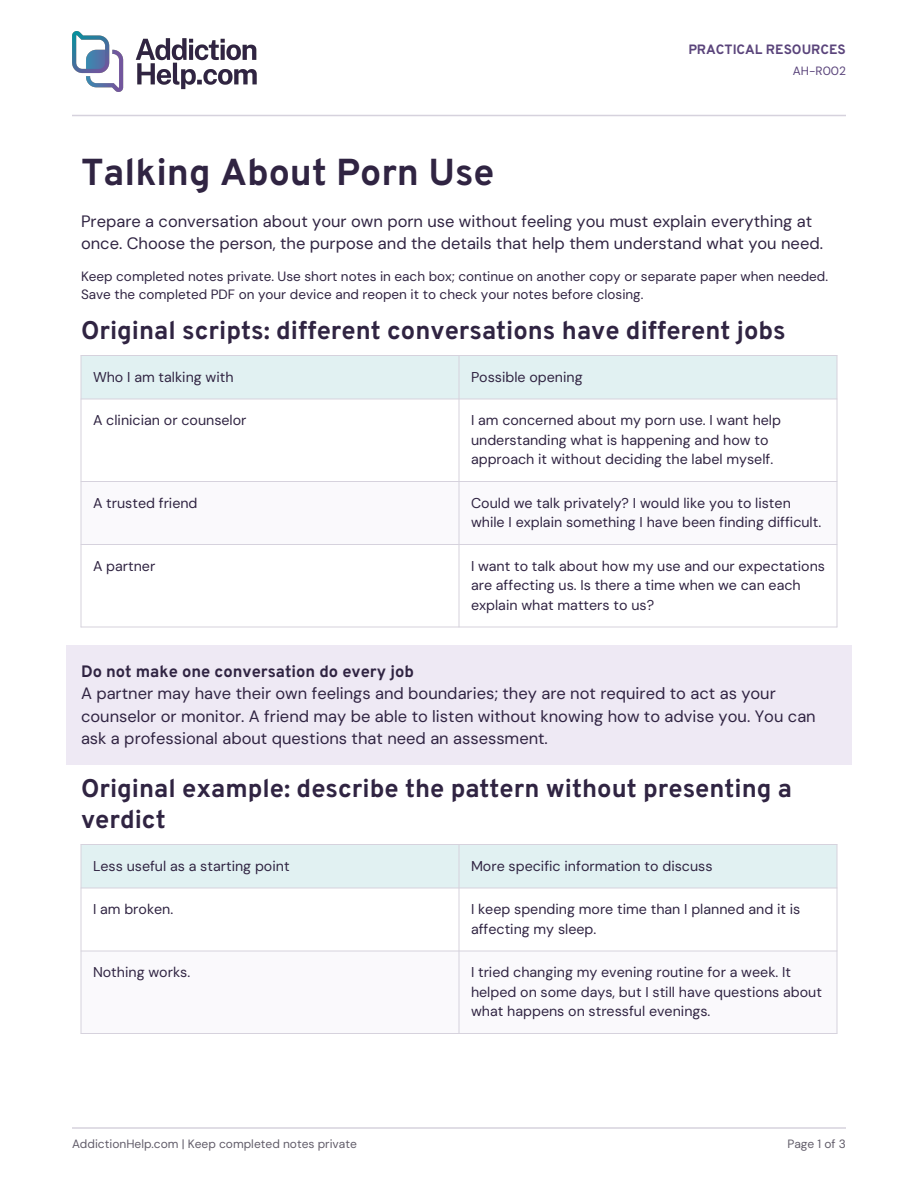
Talking About Porn Use
Prepare what you want to say about porn use and what you want to ask a counselor, partner, or trusted person.
3-page fillable PDF · Free · No signup
Types of Counseling for Problematic Porn Use
Cognitive behavioral therapy and acceptance and commitment therapy are among the approaches studied for problematic pornography use. A 2025 meta-analysis, which combined results from multiple studies, found promising results for psychotherapy, but the underlying research had important limitations. It did not establish that ACT was superior to CBT. A therapist’s explanation should include both the approach and why it fits your needs.[2]
Cognitive Behavioral Therapy for Porn Use
Cognitive behavioral therapy, or CBT, helps people recognize and change patterns of thinking and behavior that contribute to difficulties. For problematic pornography use, studied interventions have included recognizing triggers, managing urges, developing coping skills, and planning how to respond to a return to unwanted behavior.[6][1]
Consider a pattern in which stress after work leads to viewing that continues much longer than intended. A CBT discussion might examine the situation, the expectation that viewing will provide relief, and the choices available before the pattern takes over. This is an illustration of the approach, not a prescribed exercise or a claim that stress explains every person’s use.[1]
Acceptance and Commitment Therapy for Porn Use
Acceptance and commitment therapy, or ACT, emphasizes responding differently to unwanted thoughts and feelings while taking actions guided by personal values. In pornography treatment research, this has included learning to notice urges without automatically acting on them and practicing those skills outside sessions. Acceptance does not mean approving of every behavior or abandoning a goal to change.[1]
One randomized study assigned 28 adult men to 12 ACT sessions or a waiting list.[7] Participants receiving ACT reduced their self-reported pornography viewing by 93%, compared with 21% in the waiting-list group.[7] Those are changes in reported viewing in a small study, not percentages of people permanently cured. Almost all participants belonged to the same religious community, which limits how confidently the findings can be applied to other populations.[7]
An earlier study involved only six adult men and reported reductions after eight ACT sessions. It was a preliminary multiple-baseline study, not a large randomized trial. Together, these studies help explain why ACT is being investigated; they do not establish a guaranteed outcome or the best therapy for everyone.[8][7]
Mindfulness and Other Skills Used in Counseling
Mindfulness and emotion-regulation skills appear within several studied treatment programs. They may be used alongside CBT or ACT rather than as a completely separate treatment. The research does not justify assuming that any app or exercise labeled “mindfulness” has the same evidence as a structured clinical program.[1][9]
One 2024 trial illustrates why the details matter. It tested an online imaginal-retraining intervention, presented by video, in 274 participants.[10] Results were encouraging in the subgroup that met the study’s participation criteria, but the analysis including the randomized sample did not confirm the effect. Participants completed follow-up at a rate of about 52%.[10] That is a reason for caution about the intervention’s effectiveness, not evidence that people who struggle to continue are to blame.[10]
Group and Couple Counseling
Psychotherapy can take place individually, in groups, or with a partner or family. The appropriate format depends on the concerns being addressed. Sexual medicine recommendations also recognize relationship context and the potential role of couple work.[6][3]
Ask what a group is designed to do, who leads it, and how it relates to individual care. With couple counseling, clarify whether the goals include communication, relationship decisions, or concerns associated with the behavior. A partner’s needs should be discussed rather than assuming that monitoring the other person’s pornography use is the treatment plan.[3]
How Effective Is Porn Addiction Counseling?
A 2025 meta-analysis combined 20 studies involving 2,021 participants.[2] It found improvements in problematic pornography use and related outcomes, with much of the research involving CBT or ACT. The authors also identified substantial weaknesses: study quality was limited, many outcomes relied on self-report, and relatively few studies included comparison groups. Most participants were men.[2]
An earlier systematic review included 24 treatment studies, of which four were randomized controlled trials. It found preliminary support for treatment, especially CBT-based approaches, while cautioning against strong conclusions about comparative effectiveness. These findings support offering informed, individualized care; they do not support promises that one program will work for everyone.[1]
What Improvement in Porn Counseling Can Mean
Improvement may include better control over behavior, less distress, fewer harmful consequences, and changes in viewing. Research does not always show the same degree of change in every outcome. A decrease in a symptom score is different from complete cessation, and a short-term result does not establish lifelong recovery.[1][2]
Ask how your therapist will evaluate progress and when you will review the plan together. If viewing time decreases but your distress or relationship difficulties remain, that is worth discussing rather than treating one number as the entire outcome.[3][4]
How Long Does Porn Counseling Take?
There is no single established treatment length that applies to everyone. The small ACT studies used eight or 12 sessions. Other research has examined different formats and durations, making it inappropriate to promise that a particular number of appointments will resolve the problem.[8][7][1]
The PornLoS publication from 2024 describes a trial protocol with 24 individual and six group sessions, along with other supports.[11][4] It describes what researchers planned to test; it is not a report proving that this schedule works. Ask a prospective clinician about an initial plan, how progress will be assessed, and how the duration may change.[11][4]
How to Find a Porn Addiction Therapist Near You
Start with your insurer’s provider directory, a primary care referral, or local mental health services. Use your city or ZIP code to narrow a directory search, then contact the clinician to confirm their office location, experience with problematic pornography use, new-client availability and cost. If nearby appointments are scarce, ask whether online care is available where you live.[4][12][13]
Look for a mental health professional who can explain their experience with problematic pornography use or compulsive sexual behavior, their treatment approach, and their approach to broader assessment. NIMH suggests asking about experience with your concern, expected treatment length, insurance, and cost. A primary care clinician can also help with an initial mental health assessment or referral.[3][4]
Specialty experience is worth asking about directly. A German study surveyed practicing psychotherapists and treatment facilities and found substantial gaps in knowledge about pornography use disorder. That finding concerns those surveyed in Germany; it does not mean most therapists everywhere have never treated these concerns.[14]
Questions to Ask a Porn Counselor
You might bring these questions to an introductory conversation:
- What experience do you have helping people with problematic pornography use?
- How do you assess impaired control, personal values, and other mental health concerns?
- What approach do you use, and what evidence and limitations should I understand?
- How will we decide on goals and review whether treatment is helping?
- What will appointments cost, and do you accept my insurance?
- How do you handle confidentiality, records, and online appointments?
These questions combine the assessment issues described in sexual medicine guidance with NIMH’s suggestions for choosing a provider. They are prompts for a conversation, not a scoring tool or a guarantee of fit.[3][4]
Other Mental Health Concerns and Porn Counseling
An assessment should consider depression, anxiety, substance use, other psychiatric conditions, medications, and the person’s broader history. Sexual behavior changes can sometimes occur in another clinical context, so a clinician should not automatically attribute everything to pornography.[3]
If trauma is part of your history, it can be relevant to discuss. Its presence does not establish that it caused the current behavior or that a particular trauma treatment is proven to treat problematic pornography use. The treatment plan should follow an assessment of the individual concerns rather than a universal explanation.[3][1]
Online Counseling and Self-Guided Porn Programs
Mental health treatment can be offered virtually or in person. A live appointment with a licensed clinician is different from a self-guided online program, and research on one format should not be used as proof about the other.[4][5]
A six-week online self-help study enrolled 264 people and found promising improvements among participants with follow-up data.[5] However, 89% of the intervention group did not complete follow-up, compared with 45% of the waiting-list group.[5] The complete-case results therefore leave substantial uncertainty about how well the program works for everyone who starts it.[5]
When comparing options, ask whether you will have an individual clinician, how much contact is included, what happens if symptoms worsen, and what privacy arrangements apply. Cost, access, and the type of support available belong in the discussion alongside the treatment method.[4]
Comparing Online Porn Counseling Options
Choose the clinician and the service, not just the platform name. Ask whether the provider has experience with the concerns you described, how live appointments work, and how you will review progress. Virtual care can improve access, but privacy at home and reliable technology still matter.[13]
Questions About Access and Cost
Before paying, ask these practical questions:
- Can this clinician see me where I will be located during appointments?
- Does the price cover live sessions, messaging, or both?
- How often will we meet, and what happens if I miss a session?
- What are the renewal and cancellation terms?
- If I need an assessment, medication, or another level of care, how would that be arranged?
Confirm coverage with the provider and insurer. A subscription’s advertised weekly price and a per-session insurance copayment describe different billing arrangements.[13]
Preparing a First Message
You might write: “Porn use is interfering with my sleep and relationships. I would like to discuss your experience with this concern, what treatment involves, and the cost of starting.” Adapt the wording to what is actually happening for you. You can ask about qualifications and privacy before sharing more detail.[12]
For additional options, compare porn-use support resources. If a service recommends more intensive care, ask what its treatment program actually provides and why that setting fits your needs.
Find Resources for Porn Addiction Counseling
If pornography use is affecting your life, start with our Find Treatment Help resources to explore next steps and our Treatment Centers directory to research care options. Use the questions above to ask prospective providers about their experience with problematic pornography use, their approach, and the services they offer. Our Porn Addiction guide can also help you prepare for that conversation.
Frequently Asked Questions
What Kind of Therapist Should I See for Porn Addiction?
Look for a mental health professional with relevant experience in problematic pornography use or compulsive sexual behavior. Ask how they assess your concerns, address other mental health needs, and choose a treatment approach. Experience, a clear explanation of care, and a working relationship you can discuss openly all matter.[3][4]
Does Counseling for Porn Addiction Work?
Research suggests psychotherapy can reduce problematic use and related symptoms. A 2025 meta-analysis found promising results across 20 studies, but study quality, self-report measures, and limited comparison groups reduce certainty. Treatment can help without there being a guaranteed result or a single proven best method.[2]
How Are CBT and ACT Different for Porn Use?
CBT emphasizes recognizing and changing patterns of thinking and behavior. ACT emphasizes responding more flexibly to thoughts and urges while acting on personal values. Both have been studied for problematic pornography use; the available meta-analysis did not establish that one is superior to the other.[6][1][2]
Can I Get Porn Counseling Online?
How Long Does Porn Addiction Counseling Take?
What If My Distress Is Mainly About My Values?
That distress is worth discussing. Sexual medicine recommendations distinguish persistent impaired control from distress based entirely on moral disapproval. A clinician should explore your values and behavior respectfully without assuming that guilt alone proves a disorder. Both moral conflict and difficulties with control can be present.[3]
How Do I Compare Online Porn Counseling Services?
How Can I Find a Porn Addiction Therapist Near Me?
Ask a primary care clinician for a referral, search your insurer’s directory, or contact local mental health services. Ask specifically about problematic pornography use, the clinician’s license and experience, new-client availability and costs. If local options are limited, ask about online appointments where you live.[4][12][13]
Get Treatment Help
If you or someone you love is struggling with addiction, getting help is just a phone call away, or consider trying therapy online with BetterHelp.
Exclusive offer: 20% Off BetterHelp*Following links to the BetterHelp website may earn us a commission that helps us manage and maintain AddictionHelp.com. *Get 20% off your first month of BetterHelp. Offer valid for new BetterHelp users only. Offer cannot be combined with insurance.

- Fact-Checked
- Editor