What Is 7-OH?
“Have you heard of 7-hydroxy?” my colleague asked me.
No, I said, Googling it immediately. I assumed it was the latest designer drug, something horrifying like tranq dope.
I was wrong. But in some ways, it’s worse.
What if there was a substance, legal in most of the U.S., that some are calling “legal morphine” and “gas station heroin?”
There is. It’s called kratom—a controversial plant with opioid-like effects. And one of its compounds, 7-OH (7-hydroxymitragynine), is far more potent and has even been synthesized and sold separately in concentrated products.
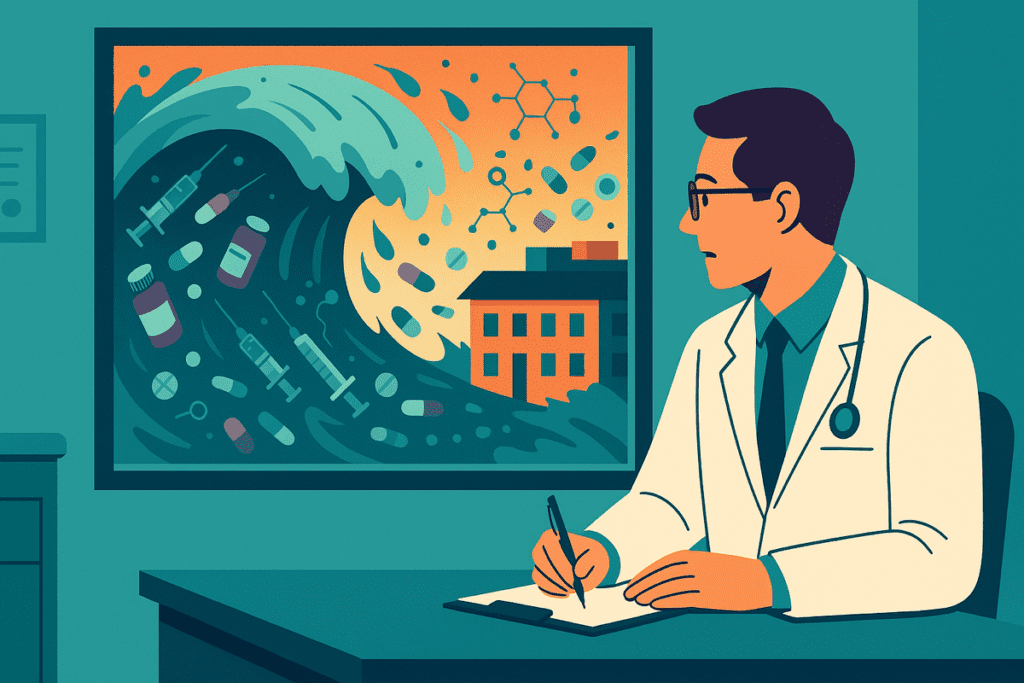
In some cases, authorities have begun to question if these products represent a “fourth wave” in the opioid crisis.”
Here’s what you need to know.
Miracle or Mess-Maker?
First of all, I have personal history with kratom. Kratom and I are not friends.
True, not everyone has a terrible experience with it like I did—but there are also lots and lots of others who have had it as bad or even worse than I did.
I understand why people are drawn to it. (I was too!) The idea of an all-natural supplement that can relieve pain and improve your mood sounds fantastic. And it definitely worked well for me at first.
I even met someone who had finally achieved sobriety and abstinence from heroin through kratom, when no other MATs could even provide that for them. (And that person remains sober to this day.)
However, for every success story like that, there are plenty of people who struggle with dependence, side effects, or flat-out bad experiences. That’s the part that doesn’t always make it into the “miracle plant” marketing.
And that’s the most frustrating part of pro-kratom culture for me: the lack of honesty about the risks, downfalls, and side effects a person might have to deal with.
Users like me are often sold this idea that they cannot possibly become dependent on it (which we now know is false).
Even if you do your own research, there are a lot of conflicting opinions out there. It’s hard to know what’s truth versus bias; what’s a carefully-crafted argument using selective data, and what’s a broader take.
Sure, it may have some benefits. But portraying kratom as almost flawless while dismissing the negatives as rare (or worse, blaming the user) is more than just misleading.
At best, it’s irresponsible. At worst, it’s predatory.
The 7-OH Effect
And this is exactly where 7-OH comes in. All those mixed experiences with kratom trace back to this one compound.
When you consume kratom, it goes through your liver just like anything else we eat or drink. In kratom’s case, it turns the active ingredient (Mitragynine) into 7-OH (7-Hydroxymitragynine).
Think of your liver as a refinery. You put in the raw material (kratom’s main ingredient, mitragynine), and the refinery processes it into a much more potent, concentrated fuel (7-OH).
Selling synthesized 7-OH directly is like skipping the refinery entirely and pumping pure, high-octane jet fuel into a regular car engine.
The natural “buffer” of your body’s metabolism is gone, leading to a much stronger and more dangerous effect.
Here’s the problem: everyone’s body makes 7-OH a little differently.
Two friends could take the exact same dose, but one might feel deeply relaxed while the other barely notices anything.
Age, weight, genetics, and even other medications all play a role in how our bodies metabolize things, including kratom.
That unpredictability is a big reason why we still have A LOT of research to do before we can determine whether kratom is safe or not.
Bans and Legality
In the U.S., kratom is illegal in Alabama, Arkansas, Indiana, Rhode Island, Vermont, and Wisconsin. Florida has gone a step further by specifically banning 7-OH itself, even though kratom is still legal in most of the state.
Kratom is also banned worldwide in Australia, Denmark, Finland, Latvia, Lithuania, Poland, Romania, Sweden, and the UK.
The reasoning almost always comes back to the same thing: 7-OH and its opioid-like effects.
Which brings us to the availability of 7-OH as a product in and of itself.
Some labs have found a way to synthesize 7-OH directly, which sellers then add to concentrated kratom extracts or make available under the guise of being a “research chemical.”
Well, that’s obviously a problem. It skips the body’s natural “buffer” of processing kratom through the liver and instead just gives people the 7-OH compound directly.
And since 7-OH is significantly more potent than ordinary kratom, we’re basically giving people an unregulated opioid hidden under the label of “natural and plant-based.”
That’s misleading. That’s predatory. That’s gross.
It’s one thing to debate the potential impacts of kratom, both positive and negative, and I hope we continue to learn more through ongoing research.
However, you’ve lost me at offering a highly concentrated, synthesized version of the stuff. That’s not designed to be supplemental. That’s designed to be exploitative.
Until we really understand it, selling 7-OH on its own is like bottling the most unpredictable parts of kratom and handing it out with no guardrails.
This content is intended for informational and harm-reduction purposes only and should not be considered a substitute for professional medical advice, diagnosis, or treatment. Always consult your physician or other qualified healthcare provider with any questions you may have regarding a medical condition.
Get Treatment Help
If you or someone you love is struggling with addiction, getting help is just a phone call away, or consider trying therapy online with BetterHelp.
Exclusive offer: 20% Off BetterHelp*Following links to the BetterHelp website may earn us a commission that helps us manage and maintain AddictionHelp.com. *Get 20% off your first month of BetterHelp. Offer valid for new BetterHelp users only. Offer cannot be combined with insurance.