How Long Does Naltrexone Stay in Your System?
Naltrexone timing differs between daily tablets and the monthly Vivitrol injection. Half-life, opioid blocking, and safe treatment changes are different questions that require formulation-specific answers.


Battling addiction & ready for help?
On this pageJump directly to a section.Show topicsHide topics
How Long Naltrexone Lasts Depends on the Form
You may be checking naltrexone’s timing because of a missed dose, a planned procedure, or a change in treatment. Daily tablets and the monthly Vivitrol injection last very different lengths of time. Drug clearance, opioid blocking, and the timing of safe medical care are related questions, but they do not have one interchangeable answer.[1][2]
Oral naltrexone has an average half-life of about 4 hours, while its active breakdown product has a half-life of about 13 hours.[1] Vivitrol releases medication gradually: its label describes opioid blocking for approximately 28 days and measurable drug levels for longer than a month.[1][2]
These times are not a countdown to safe opioid use. Trying to overcome naltrexone with more opioids can cause fatal overdose, and tolerance may be lower as treatment wears off or stops. Call 911 for suspected overdose and give naloxone if available.[2]
For suicidal or mental health distress in the United States, call or text 988. Call 911 for immediate danger or a medical emergency.[3]
- Tablet pharmacology involves both naltrexone and its active metabolite, 6-beta-naltrexol. Their average half-lives differ.[1]
- The tablet label reports opioid blocking for as long as 24 hours after a 50 mg dose in a particular experimental study.[1] That finding is not a guarantee against overdose.[1]
- Vivitrol is usually given every four weeks or once a month, but measurable medicine does not disappear abruptly on the appointment date.[2]
- Tell a clinician the formulation and exact last dose date when planning surgery, changing medication, or addressing missed treatment.[1][2]
Naltrexone Half-Life Versus How Long It Works
Half-life describes how long it takes for the amount of a drug to decrease by half. It does not mean that the drug is entirely gone after that time. As naltrexone is processed, the body also produces 6-beta-naltrexol, an active metabolite that contributes to its effects.[1]
The oral label gives average elimination half-lives of 4 hours for naltrexone and 13 hours for that metabolite. Because these are averages and there are multiple active components, a simple calculation cannot tell an individual when opioid pain medicine will work normally or when a drug test will become negative.[1]
Ask the Timing Question That Matches Your Situation
“How long is it in my system?” could mean “When is my next dose?”, “How will my pain be treated?”, or “What happens if I stop?” Tell the clinician which decision you need to make, along with the product and last dose date.
The opioid-blocking effect of naltrexone is another measure. It depends on the formulation and dose and changes over time. A medicine being measurable in blood or urine is not the same as a guaranteed degree of protection from another drug.[1][2]
How Long Do Naltrexone Tablets Block Opioids?
The tablet label describes a study in which 50 mg blocked the effects of a specified intravenous heroin dose for as long as 24 hours.[1] It also describes longer blocking with larger study doses. Those are pharmacology findings, not instructions to increase, skip, or reschedule tablets yourself.[1]
The finding should not be generalized to mean that a usual tablet provides 48 hours of reliable blocking against any opioid, any amount, or today’s fentanyl supply. The same label warns that the blockade is surmountable and that attempts to overcome it can be fatal.[1]
Tablets are commonly prescribed daily. Follow your own prescription and ask what to do if you miss a dose. If you have used opioids since the last dose, tell the prescriber before restarting because naltrexone can precipitate withdrawal in a physically dependent person.[4][1]
How Long Does the Vivitrol Injection Last?
Vivitrol is an extended-release injection into a muscle, administered by a healthcare professional. Its formulation releases naltrexone gradually. The label describes opioid blocking for approximately 28 days, with injections scheduled every four weeks or once a month.[2]
Drug levels do not drop to zero at the end of that interval. The label reports measurable levels for longer than one month and an elimination half-life of 5 to 10 days after injection. That longer half-life reflects the extended-release formulation, not the half-life of a tablet.[2]
Tablet and Injection Timing Compared
Use this comparison to identify which information belongs to your formulation. None of these measures establishes a safe time to use opioids or a personal surgical plan.[1][2]
| Timing measure | Oral naltrexone | Vivitrol injection |
|---|---|---|
| Typical treatment routine | Tablets according to the prescription, commonly daily. | Injection every four weeks or once a month. |
| Reported elimination half-life | About 4 hours for naltrexone; about 13 hours for its active metabolite. | About 5 to 10 days for naltrexone after injection. |
| Opioid-blocking information in the label | As long as 24 hours after 50 mg in a specified heroin-challenge study.[1] | Approximately 28 days. |
| Important limit | Averages and experimental blocking findings do not establish personal clearance or overdose protection. | Measurable medicine may remain beyond a month; a missed appointment still needs prompt planning. |
The values above are formulation-specific findings from the prescribing information.[1][2]
How Soon Does Naltrexone Start Working?
After an oral dose, naltrexone and its active metabolite reach peak blood levels within about an hour. Vivitrol has an early peak about two hours after injection and another peak roughly two to three days later. These blood-level findings do not mean treatment success or craving relief follows an exact hourly schedule.[1][2]
For alcohol treatment, the aim is to help reduce the urge to drink over the course of care. For opioid treatment, starting safely and remaining engaged with treatment matter alongside receptor blocking. Tell the team if cravings continue or the treatment routine is difficult to maintain.[4][5]
What Can Change Naltrexone Clearance?
The formulation is a major difference, but liver and kidney health also matter. Oral naltrexone is extensively metabolized, and naltrexone and its metabolites are primarily eliminated in urine. The tablet label advises caution with kidney impairment and describes increased exposure in people with cirrhosis.[1]
Injection data are different: Vivitrol’s pharmacokinetics have not been evaluated in severe liver impairment or moderate-to-severe kidney impairment. Tell the clinician about these conditions rather than applying a healthy-volunteer average to your situation.[2]
Naltrexone Timing Before Surgery or Pain Treatment
Tell the care team about naltrexone as soon as a procedure is being planned. Include whether you take tablets or receive injections and when the last dose was given. Do not cancel pain care because you assume nothing will work. Clinicians can consider nonopioid medicines, regional anesthesia, and other approaches.[1][2]
If opioids are necessary while naltrexone is active, specialist management and close monitoring may be required. Attempts to overcome blocking can lead to deeper or longer breathing suppression. Decisions about pausing and restarting naltrexone need coordination between the pain team and the clinician treating the substance use disorder.[1][2]
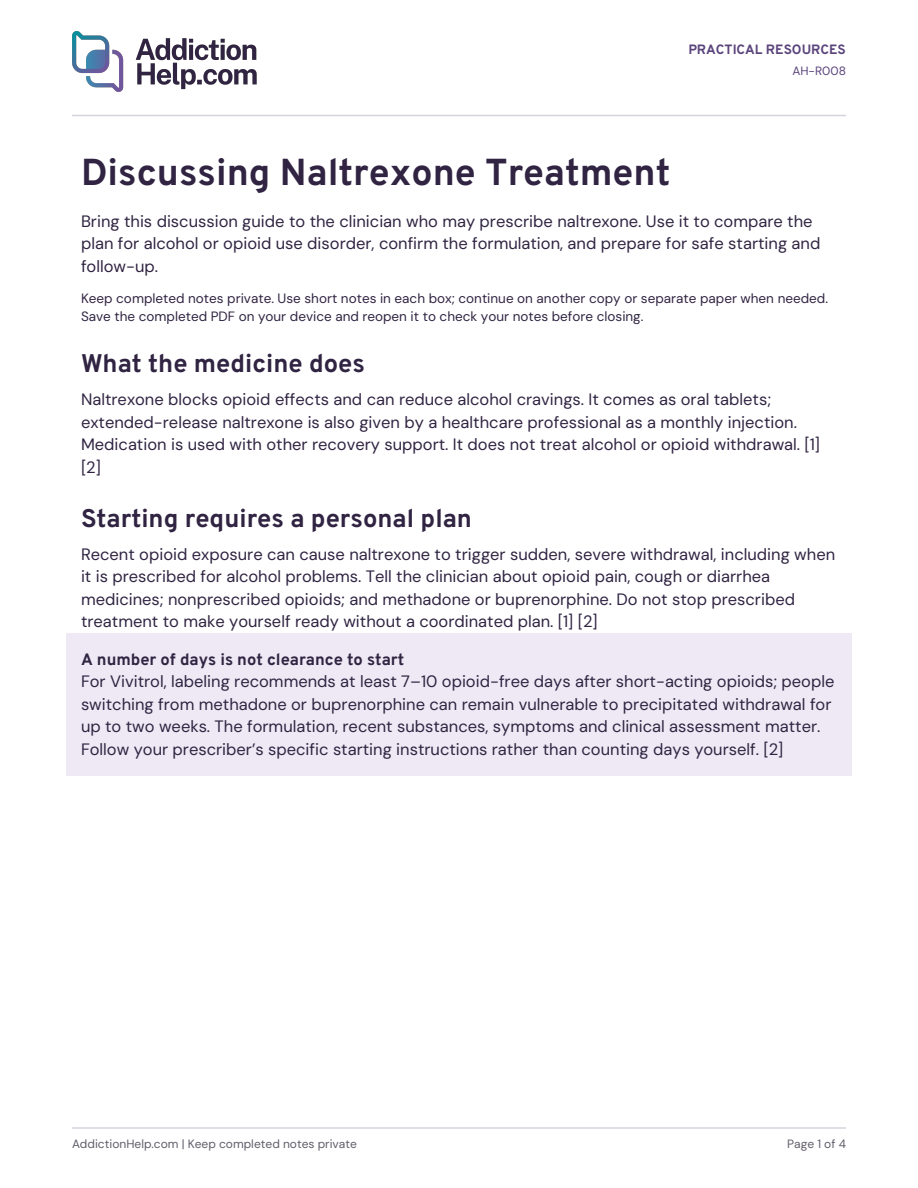
AddictionHelp.com · Practical resources
Discussing Naltrexone Treatment
Bring this discussion guide to the clinician who may prescribe naltrexone. Use it to compare the plan for alcohol or opioid use disorder, confirm the formulation, and prepare for safe starting and follow-up.
4-page fillable PDF · Free · No signup
How Long Must You Be Opioid-Free Before Starting?
The waiting period before the first dose is a different question from how long naltrexone lasts afterward. Labeling recommends at least 7 to 10 opioid-free days after short-acting opioids. People transitioning from methadone or buprenorphine may remain vulnerable to precipitated withdrawal for as long as two weeks.[2]
The clinician must assess readiness. Neither a negative urine test nor a tolerated naloxone challenge guarantees that sudden withdrawal cannot occur. Describe all recent opioid use, including prescribed pain medicine and tramadol. Withdrawal support may be needed, with the setting chosen for your circumstances.[2]
Staying Supported if a Dose Is Missed or Treatment Ends
Contact the treating team if you miss an injection or are considering stopping. Naltrexone itself does not cause opioid physical dependence, but after time without opioids your tolerance may be lower. A previously tolerated amount can then cause overdose as blocking declines or disappears.[4][2]
Keep naloxone available and make a plan for cravings, a return to use, and follow-up. Use the worksheet to prepare your medication questions, review naltrexone treatment choices, and explore recovery support. If you need a prescriber, help finding treatment is a place to start.
Frequently Asked Questions
Does Naltrexone Show Up on a Drug Test?
It depends on the test. The tablet label says interference with some opioid-testing methods depends on the specific assay and recommends consulting the test manufacturer. Tell the testing clinician about your prescription rather than assuming all panels behave the same way.[1]
When Will Opioid Pain Medicine Work After Naltrexone?
Can You Overdose Trying to Overcome Naltrexone?
Yes. The opioid blockade is surmountable, and attempts to overcome it can cause fatal overdose. Call 911 for suspected overdose and give naloxone if available.[2]
How Long Does a Vivitrol Injection Last?
Its label describes opioid blocking for approximately 28 days and measurable naltrexone levels for longer than a month. These measures do not establish a safe time to use opioids.[2]
Why Does Naltrexone Half-Life Not Tell the Whole Story?
Why Is an Opioid-Free Period Needed Before Naltrexone?
Labeling recommends at least 7 to 10 days after short-acting opioids; vulnerability after methadone or buprenorphine can last as long as two weeks. A clinician must assess readiness because time and testing alone cannot guarantee a safe start.[2]
Get Treatment Help
If you or someone you love is struggling with addiction, getting help is just a phone call away, or consider trying therapy online with BetterHelp.
Exclusive offer: 20% Off BetterHelp*Following links to the BetterHelp website may earn us a commission that helps us manage and maintain AddictionHelp.com. *Get 20% off your first month of BetterHelp. Offer valid for new BetterHelp users only. Offer cannot be combined with insurance.

- Fact-Checked
- Editor

