Hospital Addiction Treatment and the Gap After Discharge
A Seattle pilot examines the step between starting buprenorphine and receiving outpatient care, where referrals and medication plans must become actual connections.
Starting Buprenorphine and Connecting With Outpatient Care
Starting medication in a hospital and connecting with a clinician after discharge are two different steps. A small Seattle study illustrates why the second deserves its own attention: among 40 participants who started buprenorphine, researchers documented an outpatient medication-treatment encounter within 30 days after discharge for 10 of 20 receiving usual care and 11 of 20 receiving added support.[1]
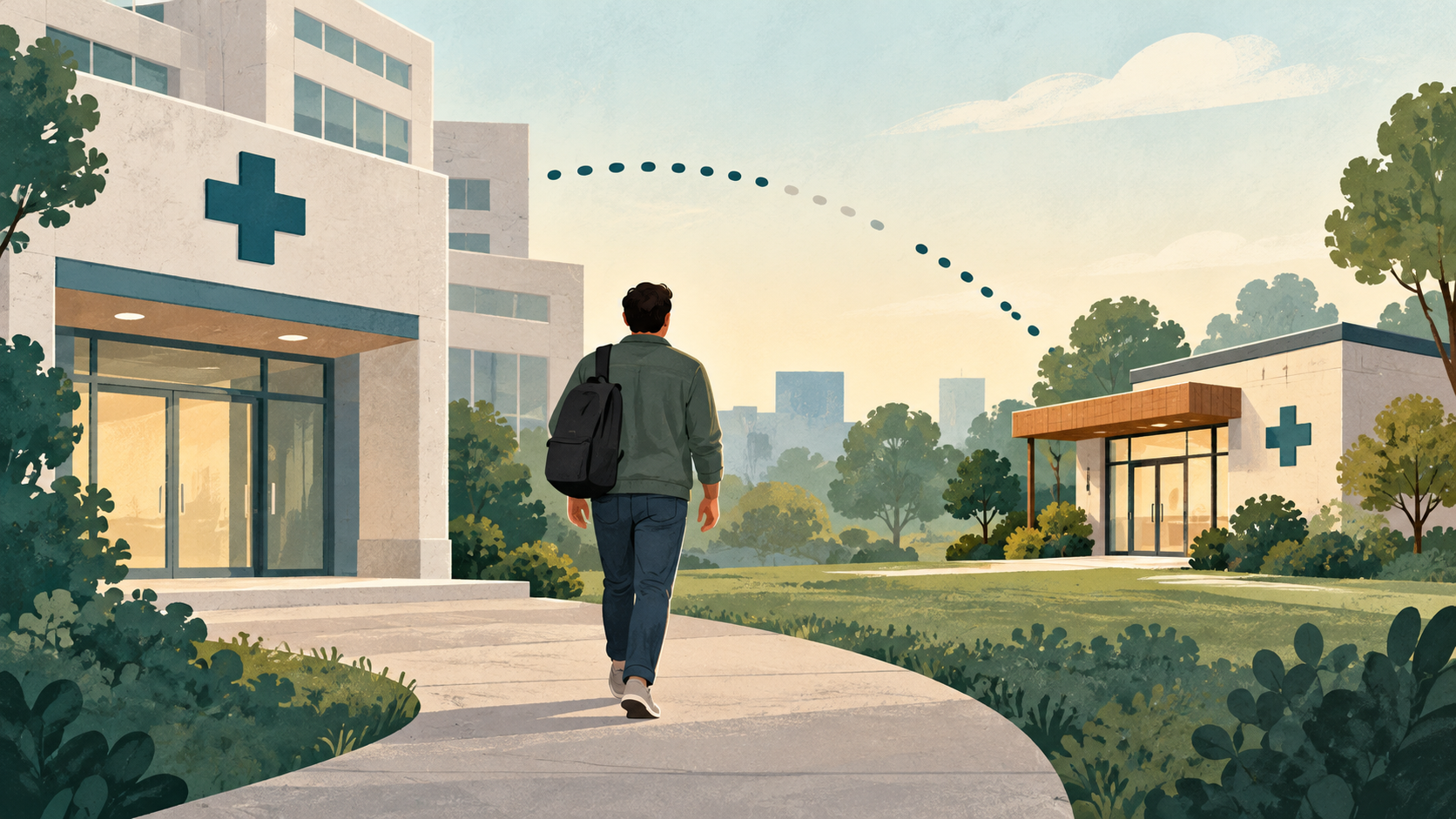
The MIAPP pilot was published online in JAMA Network Open on October 13, 2026.[2] It tested patient navigation, smartphone tools and financial incentives alongside usual hospital addiction care. Its results were already public on ClinicalTrials.gov on May 27. The study offers a close look at one transition in treatment, rather than a verdict on whether medication or navigation works.[1]
- MIAPP study groups both received usual addiction care. The pilot tested additional support, not treatment against no treatment.[1]
- The main outcome was a documented outpatient medication encounter. It did not establish uninterrupted medication use or sustained recovery.[1]
- The pilot was designed to assess feasibility and acceptability. Its small size could not reliably establish a difference between groups.[1]
What the Seattle Pilot Tested
The study enrolled adults at one large Seattle hospital who started buprenorphine for opioid use disorder during their stay or at discharge. Participants also had used methamphetamine within the previous 30 days and planned to continue buprenorphine after leaving the hospital.[1]
That makes this a specific study population, not a sample of everyone who receives hospital addiction treatment. Enrollment also required willingness and ability to use a smartphone and work with a navigator. The study could provide a phone when needed.[1]
Researchers randomly assigned 20 people to usual care and 20 to usual care plus MIAPP.[1] The usual-care service included addiction physicians, specialized nurses, counselors, peer recovery supports and program coordinators. The added program combined a patient navigator with an app for communication, telehealth, medication-taking videos and financial incentives.[1]
The 2025 study protocol described the intended combination of human help and mobile technology. The study design asked participants in the added-support group to upload daily medication videos during the 30 days after discharge. The registry explicitly says the design instructed participants to continue taking medication as prescribed if they could not upload a video. Missing a video upload was not meant to interrupt medication.[1][3]
What “Connected to Treatment” Actually Meant
The main outcome counted a documented outpatient encounter at which a medication for opioid use disorder was provided or prescribed within 30 days after discharge. The encounter could be in person or by telemedicine. It could involve buprenorphine, methadone or naltrexone, even though participants entered the study after starting buprenorphine.[1]
| Study group | Participants with a documented qualifying encounter |
|---|---|
| Usual hospital addiction care | 10 of 20 |
| Usual care plus navigation, app support and incentives | 11 of 20 |
These are counts from one small pilot, not national rates of continuing treatment. They should not be described as the number who took buprenorphine continuously, avoided opioid use or remained in recovery. Those are different questions from whether a qualifying encounter was documented.[1]
The difference was one participant. That does not prove the added support helped, failed or performed the same as usual care. The registry states that the pilot was not powered to detect statistically significant differences. Its main purpose was to assess whether the researchers could recruit participants and deliver an intervention people could use.[1]
The registry also reports a separate measure of continued treatment: days with medication coverage during the 90 days after discharge. The average was 23.9 days with usual care and 18.7 days with added support, with 20 participants in each group.[1] Coverage could involve buprenorphine, methadone or naltrexone. This measure goes beyond whether one visit occurred, but it does not establish sustained recovery.[1]
These were secondary outcomes from the same small pilot. The numerical difference does not establish that added support worsened retention, just as the 30-day counts do not establish a benefit. The registry also reports hospital readmissions, emergency visits and self-reported substance use. Those outcomes need the same caution and should not be singled out as proof that the program worked or failed.[1]
The distinction matters beyond this particular trial. A medication start means treatment has begun. A referral identifies a next place to seek care. A completed encounter shows a further connection. None of those steps, on its own, establishes that treatment continued over the following months.
Why a Referral May Not Become a Completed Visit
A discharge plan depends on more than a patient’s willingness to follow it. Separate research has documented hospital providers’ concerns about long waits, limited access to prescribers and poor connections between hospital and community services.[4]
In a study led by Riley Shearer and published online in November 2024, researchers interviewed 57 providers at 12 community hospitals. Providers described difficulty knowing where patients could continue medication treatment. Some did not know which community clinicians prescribed buprenorphine. Others described outpatient services that operated separately from the hospital, making coordination harder.[4]
Those interviews took place from November 2021 through March 2022 at hospitals without established hospital-based opioid treatment programs or addiction consultation services. They represent those providers’ experiences and perceptions. They are not a current national estimate of access, and they do not explain why any particular MIAPP participant did or did not have a documented follow-up encounter.[4]
The providers also described ways to make the connection more concrete. These included relationships with outpatient clinics and community treatment staff meeting patients before discharge. That kind of direct introduction, often called a warm handoff, gives the next team a role before the patient leaves. The study identified these as proposed or reported approaches, not proven solutions for every hospital.[4]
Together, the two studies raise a useful question for hospital care: who is responsible for helping the next step actually happen? The Seattle pilot tested one added-support model. The provider interviews describe organizational obstacles that a discharge instruction alone may leave unresolved.
Three Questions to Clarify Before Leaving the Hospital
For someone starting medication treatment, the practical issue is what happens between the hospital and the next clinician. These questions are editorial prompts drawn from the transition problems described in the provider study. They are not a tested checklist or a substitute for an individual discharge plan.[4]
- Who will provide my next treatment visit? Ask for the clinician or program name, how to reach them, and whether an appointment is confirmed or still needs to be arranged. If it is a video visit, ask what you need to join.
- How will I access my medication until that visit? Ask the hospital team to explain the prescription or medication plan and what to do if there is a problem obtaining it. Have them clarify any gap between leaving the hospital and seeing the next clinician.
- Who should I contact if the plan breaks down? Ask for a specific person or service to call if the appointment falls through, transportation is unavailable or the medication cannot be obtained. Clarify who can help revise the plan.
If you are helping someone else, you can offer to write down the answers or help make a call with their permission. A clearer plan cannot remove every barrier, but it can reveal which arrangements still need attention before discharge.
For a broader explanation of the medication itself, including its role in treatment, read about buprenorphine for opioid use disorder. The immediate question to bring to the hospital team is specific: “Who will help me continue this treatment after I leave?”
If you are in crisis or thinking about suicide, call or text 988.
Get Treatment Help
If you or someone you love is struggling with addiction, getting help is just a phone call away, or consider trying therapy online with BetterHelp.
Exclusive offer: 20% Off BetterHelp*Following links to the BetterHelp website may earn us a commission that helps us manage and maintain AddictionHelp.com. *Get 20% off your first month of BetterHelp. Offer valid for new BetterHelp users only. Offer cannot be combined with insurance.