The planned 2027 trial focuses on the first month after discharge, when researchers want to know whether ketamine added to other support can help patients begin recovery.
Testing Inpatient Ketamine for the Weeks After Discharge
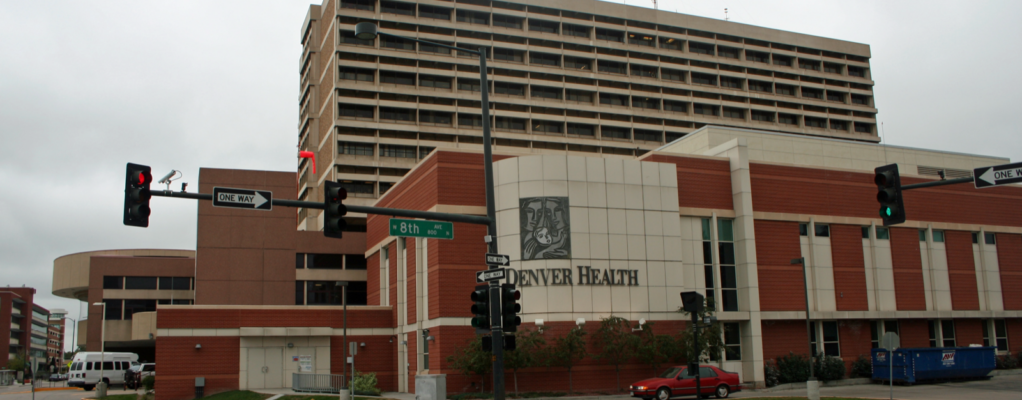
Denver Health Medical Center in 2008. Photo: Jeffrey Beall / Wikimedia Commons, CC BY-SA. Resized.
Denver Health plans to study whether ketamine given during a hospital stay can help people with severe alcohol use disorder after they return home. In an October 13 announcement, the hospital said a trial expected to begin in 2027 will compare higher and lower doses, then follow participants for four weeks to examine drinking and alcohol-related hospital readmissions.[1]
The project is backed by a five-year career-development award from the National Institute on Alcohol Abuse and Alcoholism (NIAAA). It builds on a small Denver pilot conducted in 2021 and published in 2022. That earlier work showed researchers could deliver the interventions in a medical hospital, but it did not establish that ketamine reduced readmissions.[1][2][3]
- The 2027 trial is a research plan, with no results announced. Denver Health describes ketamine as an addition to other support for hospitalized patients with severe alcohol use disorder.[1]
- The earlier pilot included support in every group. All 44 participants received enhanced connections to an outpatient addiction clinic, including those assigned no study medication.[3]
- Continuing care can take several forms. Counselor check-ins, peer recovery coaching and mutual-support groups are examples in NIAAA guidance. The Denver announcement does not specify which services the new trial will provide.[1][4]
Why the Denver Study Focuses on Leaving the Hospital
The study asks whether treatment started in the hospital can help patients during the transition back to daily life. Dale Terasaki, MD, a Denver Health internal medicine physician and addiction medicine specialist leading the project, described both the motivation and the difficulty of that transition in the hospital’s announcement.[1]
“Patients with severe alcohol use disorder often leave the hospital highly motivated to make a change,” Terasaki said in the October 13 announcement. He explained that the period immediately afterward can be difficult and that the study will investigate whether ketamine can create an opportunity for recovery during that time.[1]
In written answers to AddictionHelp.com relayed by Denver Health’s media office on October 22, Terasaki described ketamine as a one-time addition to inpatient care. He said the hospital’s addiction consult service provides medication assistance, counseling and connections to treatment after discharge. His answer did not specify which services participants will receive during their first month at home.[5]
What the Planned Ketamine Trial Will Compare
Researchers plan to compare higher and lower ketamine doses administered during hospitalization. The federal grant summary proposes a trial of 70 participants with alcohol use disorder and frequent hospital use.[2] That number is a proposed enrollment target, not a count of people already enrolled.[1][2]
The grant also proposes checking participants’ reports of drinking against an alcohol biomarker called phosphatidylethanol, or PEth. A biomarker is a biological measurement that can provide another source of information. Here, the aim is to corroborate reported changes in drinking, an issue that proved difficult in the earlier pilot.[2][3]
Terasaki said he expects the lower dose to remain noticeable, even though he does not expect the same therapeutic effect as the higher dose. The aim is to leave participants and researchers uncertain about which treatment was given and reduce the influence of expectations. That is a design intention, not evidence that the lower dose is inactive or that masking will succeed.[5]
A comparison between two ketamine doses answers a different question from a comparison with no ketamine. As described publicly, the planned trial could help researchers assess outcomes at the two doses. It would not, by that comparison alone, establish that ketamine is better than a discharge plan built around established alcohol medications and follow-up care.[1][2]
“This study will not give a definitive answer if the therapy should be offered or not, but it will help us learn what occurs acutely and how big the effect might be as we plan for more research.”
— Dale Terasaki, MD, in written answers to AddictionHelp.com[5]
The five-year award supports research training and mentorship as well as the project. Its funding period runs from September 2026 through August 2031. That period is distinct from the clinical trial’s expected 2027 start, and the announcement is not an invitation to enroll.[1][2]
The hospital trial concerns alcohol use disorder rather than ketamine therapy for depression. The broader award also proposes a separate analysis of national surveillance data to ask whether an alcohol use disorder diagnosis is associated with higher odds of risky ketamine use. The grant identifies non-prescribed use and development of substance use disorder as concerns warranting study.[1][2]
What the Earlier Denver Pilot Found
The earlier pilot randomly assigned 44 adults with severe alcohol use disorder and prior alcohol-related hospital or emergency care to three groups: an intravenous ketamine infusion, an injection of naltrexone, or help connecting with outpatient treatment without a study medication.[3] All three groups received that enhanced connection to outpatient care.[3]
For the main clinical outcome, a return to the hospital for any reason within 30 days, 2 of 13 people assigned ketamine were readmitted, compared with 7 of 17 in the linkage-only group.[3] The difference was not statistically significant (p = .17). The study therefore did not establish that ketamine prevented readmissions. This primary outcome was not limited to alcohol-related admissions.[3]
The comparison also had an important medication restriction. Hospital teams were instructed not to prescribe oral naltrexone, acamprosate or disulfiram at discharge, although appropriate medications could be offered at follow-up. Consequently, the pilot cannot show that ketamine outperforms care that includes those discharge medications. This was a rule of the earlier pilot, not a confirmed rule for the planned 2027 trial.[3]
There were other reasons to treat the findings as preliminary. The study was small, participants and researchers knew which treatment was assigned, and the authors noted differences between the groups at the start that could have favored the medication groups.[3]
Follow-up created a separate challenge: too few participants provided the later self-reports needed for a robust comparison of changes in drinking. Hospital readmissions, emergency visits and clinic attendance were assessed through electronic health records for all 44 participants.[3] Those records helped measure service use, but did not resolve the missing information about drinking.[3]
For the new study, Terasaki said researchers plan a dedicated research follow-up visit, a stronger incentive to attend and weekly engagement. He also noted that the study may select people who are better able to attend.[5]
These plans could improve follow-up, but they do not establish how well the findings will apply to patients who struggle to return. His answer did not explain how missed visits or missing drinking measurements will be handled.[5]
The pilot authors reported no serious adverse events and no known ketamine use after discharge. Blood pressure rose after ketamine and the increases lessened during monitoring. Only six people in the ketamine group supplied follow-up adverse-event data.[3]
The pilot also excluded people considered too medically ill for the interventions, including those with certain serious liver, kidney, heart, blood-pressure or stroke-related conditions, as well as people with active psychosis or suicidality, pregnancy or breastfeeding, or a substance use disorder other than alcohol, tobacco or cannabis. The small study, selected participants and limited follow-up cannot establish safety for everyone or rule out uncommon harms.[3]
If you are in crisis or thinking about suicide, call or text 988.
The pilot’s useful contribution was showing that this kind of hospital study was feasible and identifying what a next study needs to measure more clearly. The proposed effort to corroborate drinking reports follows directly from that measurement problem.[2][3]
What Continuing Care After an Alcohol-Related Hospital Stay Can Include
Continuing care means support that carries on beyond an initial period of treatment. NIAAA’s Alcohol Treatment Navigator describes several possibilities, tailored to a person’s needs. These are general examples, not confirmed services in the Denver trial.[4]
- Counselor check-ins: A professional may call periodically to see how someone is doing and provide or arrange additional support.
- Peer recovery coaching: A peer recovery support specialist can provide individual support.
- Mutual-support groups: Groups such as Alcoholics Anonymous or SMART Recovery give people a place to share experiences and support with peers.[4]
These services address different parts of the transition home. A scheduled counselor call provides a chance to identify additional needs. A peer coach offers individual support, while a group offers a network of people sharing recovery experiences. NIAAA also identifies recovery housing as an option for people who need more time and support moving from a structured setting into the community.[4]
Drawing on NIAAA and NIH guidance, a useful starting question for a patient or family preparing for discharge is: Which services will continue after I leave, and who will be responsible for my follow-up care? Naming the service and the person or team responsible makes the care plan more concrete than the word “support” alone. This question applies whether or not research participation is being considered.[4][6]
If a trial is offered, NIH’s participant guidance suggests asking about other treatment options, who will oversee care and whether regular medications can continue. Those questions are especially relevant here because the older pilot’s medication restrictions cannot be assumed to apply to the new study. The answers need to come from the current study team and consent information.[3][6]
The planned Denver trial may add to what researchers know about treatment during this transition. For someone making a care plan now, medications for alcohol use disorder and NIAAA’s continuing-care guidance can help make the next conversation specific: what treatment is available, what support fits, and how care will continue after discharge.
If you are in crisis or thinking about suicide, call or text 988.
People We Spoke With
Dale Terasaki, MD, Denver Health provided written answers about follow-up, inpatient support and the two-dose comparison through the hospital’s media office. He is describing his own research, not providing an independent assessment of the study.[5]
Sources and Attribution
This story draws on public documents, previously published remarks and original written answers from the study investigator relayed by Denver Health’s media office.[5] Denver Health employs the lead investigator and issued the announcement. NIAAA funds the new award and separately publishes the general continuing-care guidance cited here.[1][2][4]
The 2022 pilot reports funding from Denver Health’s Pilot Study Grant Program for Junior Investigators. Its authors stated that the funder had no role in the study and declared no competing interests. Those disclosures concern the earlier pilot.[3]
Get Treatment Help
If you or someone you love is struggling with addiction, getting help is just a phone call away, or consider trying therapy online with BetterHelp.
Exclusive offer: 20% Off BetterHelp*Following links to the BetterHelp website may earn us a commission that helps us manage and maintain AddictionHelp.com. *Get 20% off your first month of BetterHelp. Offer valid for new BetterHelp users only. Offer cannot be combined with insurance.